MY CLICK. Get yours at bighugelabs.com/flickr

LinkWithin

Blog Widget by LinkWithin

Booked your hotel here.

Monday, January 30, 2012

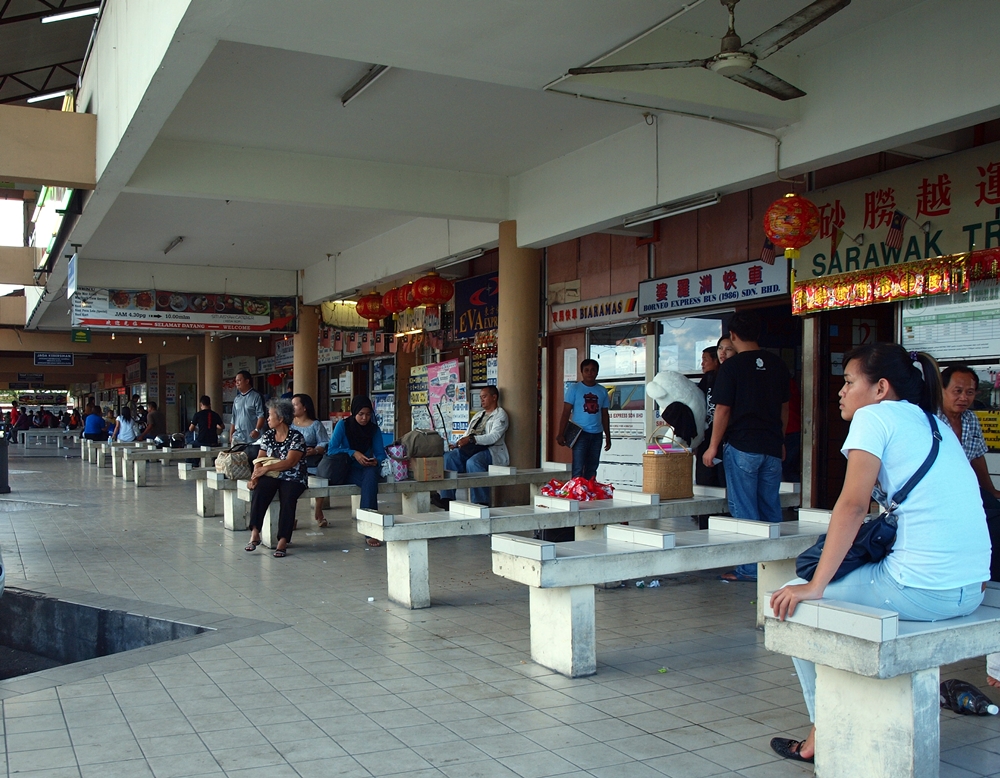
Present Kuching's Regional Express Bus Terminal.

Kuching's regional express bus terminal is located along Jl. Datuk Tawi Sli, also dubbed as "3 and a half miles", located south of the city, just before the Boulevard shopping mall. All long-distance express buses arrive from and leave for major Sarawak cities like Sibu, Bintulu and Miri, as well as Kalimatan Barat, Indonesia.
 Regional buses for some towns near Kuching such as Lundu (for the Gunung Gading National Park and Tanjung Datu National Park) and Sri Aman also arrive/depart from here.
Kuching Bus Terminal(Present).
 The completion of new bus terminal for more info read here KUCHING SENTRAL

Thursday, January 26, 2012

Business As Usual.

Business as usual for many people on 3rd day after Chinese New Year.Perhaps you want to see the photos that I shot yesterday around the old part of Kuching City.
 By now I am sure a lot of you are eager to know when is the best day in 2012 for you to start working again after this Dragon Chinese New Year.Well, not for this uncle he say I even work on celebration day.

My boss a Chinese towkey is at home and he ask me to look after the shop say Agus..My boss  say it is important for him to start working again on an auspicious day after Chinese New Year, so that his whole year will be a prosperous, smooth-sailing year filled with all the luck and wealth that he need. So if you had a bad year last year, it was probably because you started working on the wrong day after Chinese New Year! So don't make the same mistake again in this new Dragon Year.
 Business as usual say auntie ..people will come at last minutes and I don't mind waiting and I work half day to-day.
As for me I don't have any BEST day to start working I do have several so-called GOOD days to work after my break. 

The 3rd day of Chinese New Year business as usual....

Tuesday, January 24, 2012

Kuching City-Street Free of Vehicle On The First Day Of Chinese New Year.

Following Chinese New Year and long weekend holiday,the street in Kuching City are free of traffic on the first day during Chinese New Year Celebrations.
Picture  #1 &2  is the most important and busiest street in Kuching City can see be seen empty on the first day of the Chinese New Year.
 Most of the shop is still close...

Some of the main street showing an empty and ghostly ....
Showing an empty and ghostly Carpenter Street.

Monday, January 23, 2012

Farewell To Wet & Sunday Market At Satok in Kuching.

Satok, situated in the city North of Kuching was once a Malay kampung (village).Sunday Market in Satok become one of the most popular tourist attractions and visited by tourists in and outside Malaysia. Night eateries known a Benteng, which only operate at night enable visitors and the locals enjoy the various food, including Kolok mee, and Laksa Sarawak.Soon that popular Sunday Market of Satok will be moved to the new place next to Kubah Ria in Petra Jaya.To read more about this article kindly visit this blogspot by Encik Yusuf  Muhammad YM's MIND.
Old Satok Market (23/01/2012)
Satok Market in Kuching City has to be the most interesting market to-day. First time visitor can easily spent 2-3 hours wondering in the maze of stalls and lost admist the noisy marketplace.
Durian King of fruits.
 " Visitors should not miss Pasar Satok as the busy market offers views of diverse cultures, a cacophony of unfamiliar languages (especially for those familiar with standard Malay and English) and an assortment of products"


The Satok Weekend Market on Jalan Satok starts on Saturday afternoon when traders bring produce from their farms and continues on till Sunday. There are also many unique ferns and plants, wild honey, wild orchids, traditional herbs (used as medicine) and fruits from the jungles. Handicrafts and ethnic carvings are also available. There are a wide variety of snacks and sometimes snakes in baskets!(Qouted by Tourist )
The market cannot consider as big, only coverred few streets, but offered a lot of local food and fruits
Some Old Building in Satok.
Old Shophouses in Satok.
The Satok market is often listed as a tourist attraction in Kuching, but unless you're a keen photographer it probably won't hold much appeal. The produce is cheap and fresh and the environment interesting to walk around, but it also gets very hot and crowded especially during weekend.

Posted on December 4, 2011, Sunday
KUCHING: Traders at Satok market are expected to move to Medan Niaga Satok, next to Kubah Ria, in Matang Road in March next year.(March 2012).
The what so call Medan Niaga Satok situated just beside the new Kubah Ria in PetraJaya. would have five main complexes.
 About 1,400 traders from the present Sunday market and 280 from Satok Tamu market are expected to operate at the new location.Medan Niaga Satok has 19,000 trading spaces, complete with a water system and a proper rubbish disposal system compared to the one at Satok market.
 These new facilities would provide better comfort to the traders in Satok market. Added with modern design and cleaner market waste management system, rest assured that both the traders and customers would find this new market both convenient and appealing.
One of the priorities of this project focuses on cleanliness, be it internally or to its surroundings.
As part of the city’s transformation programme, this complex is a project to help the low income group and with the tourism centre and remember that these new facilities would provide better comfort to the traders in Satok market.


Sunday, January 22, 2012

Kota Sentosa.

Kota Sentosa is a unique place in Sarawak because the town grew in a linear development pattern. It is situated at the 7th mile from Kuching city and from history it grew from a tiny village that was located along the former railway line from Kuching to Mile 10. It is for this matter that Kota Sentosa's old name was 'Mile 7 bazaar'. It is also conveniently situated at the entrance of the Samarahan Division and next by the Kuching International airport. But what makes the town alive and kicking , indeed thriving is the presence of half a dozen of military-cum- residential complexes that house many battalions and regiments of the Malaysian army and air force. Their presence become the largest employment and business generator for booming Kota Sentosa.
  Kota Sentosa,state seats that held by DAP.Currently is under heavy development of modern shop houses.Yesterday I went to Kota Sentosa arm with my old camera Olympus with kit lens.Most people would just dump their older camera and equipments into the used market, and quickly grab that latest released camera that promises better image quality and camera performance.To be honest I still love my E410.
All images in this Kota Sentosa entry shot with my Olympus E410 .More picture below :::
Kota Sentosa Wet Market.
Kota Sentosa Street vendor.
Night market or pasar malam in Kota Sentosa.
Night market food stall business hour is from 6pm to midnight daily.
Old shop houses still exit in Kota Sentosa.
 Almost all the building in Kota Sentosa is colorful .

Saturday, January 21, 2012

Kuching Sentral.


This news was posted on Thursday, May 22, 2008 .
 KUCHING: Chief Minister Pehin Sri Haji Abdul Taib Mahmud yesterday unveiled Kuching Sentral (Kuching Integrated Regional Bus Terminal), the city’s latest landmark.Earthworks on the fully integrated three-storey regional bus terminal commenced in December last year. The RM55 million project, located on a seven-acre site, at Mile 6 1/2 Penrissen Road, is expected to be completed by the end of 2009. It will be only two minutes from the Kuching International Airport (KIA) and 10 minutes from Kuching City centre.

My experience is 5 or 10 minutes from Kuching Airport & at least 25 to 30 minutes from Kuching City..Our Sarawak Chief Minister say two mins from airport & 10 mins from Kuching City because he can skip the traffic congested due escorted by Police motorcycle & police mobile.......
Kuching Sentral latest picture snap 21 January,2012 by Awang.
 This news was Posted on January 12, 2012, Thursday.
The opening of Kuching Sentral, a bus terminal located at 6th mile, Jalan Penrissen, a short distance from Kuching Airport and the old Sarawak Government Railway Corridor. The terminal was supposed to open in December 2010 but the projected open date is now March 2012.
Kuching Sentral entrance.
 The RM100-million Regional Bus Terminal known as Kuching Sentral located at Mile 6, Jalan Penrissen will provide a new dimension for public transport services in the state and expected fully operation on March 2012.Though the project was slightly delayed, the contractor was committed to finishing it.

Strategically located five minutes drive from Kuching International Airport, Kuching Sentral will form a new hub for the transportation industry and will cater for regional express buses travelling on daily routes to Sri Aman, Sarikei, Sibu, Pontinak, Brunei and Sabah.t will be able to accommodate about 12,000 passengers when fully operational.

 It is an integrated complex with retail stores, hypermarkets, food court, kiosks, restaurants and international fast food outlets.Public facilities comprise bus bays, car and motorcycles parks, taxi stands, commercial van bays, luggage facilities services, surau, ticketing counters and an air-conditioned waiting area.
 Kuching Sentral will be a modern air-conditioned bus terminal with peoples’ comfort in mind but nothing is free in this world so kindly pay your parking ticket here..Thank You.

Tuesday, January 17, 2012

Nasi Minyak (which literally translates to ‘oil rice’).

Nasi minyak is a traditional Malay dish and can be found almost everywhere in Malaysia. In fact, it is so popular that different states have different ways of cooking it. Nasi minyak is a must-have at big celebrations and Malay weddings (a common local joke is that to find out when a Malay friend is getting married, just tease them about when they will be “serving you nasi minyak”)
Nasi Minyak (wich literally translates to 'Oil Rice".
 Malaysia boasts many local gastronomic delights that are unique to each culture. One of the most popular local dishes is nasi minyak (which literally translates to ‘oil rice’).In terms of appearance, nasi minyak is easily distinguished by the light yellow shade of its rice (though sometimes other colours are added using drops of food colouring). As can be guessed from its name, nasi minyak is typically cooked with ghee/oil which causes the rice to develop a rather oily texture. Once cooked, it emits a fragrant smell and a slightly buttery taste which provides a delicious contrast when served with spicier gravies such as curry and sambal. Cashew nuts and raisins can only be mixed with the rice to produce a more delicious flavour
  Malay weddings (a common local joke is that to find out when a Malay friend is getting married, just tease them about when they will be “serving you nasi minyak”).
 Nasi minyak is a must-have at big celebrations and Malay weddings.
As a type of traditional food, nasi minyak holds a special place in the hearts of many Malaysians simply for the comfort and familiarity of home that it symbolises. For Malays in particular, it represents unity and harmony during social gatherings. However, the beauty of food lies in its universality and ability to leave an impact not only on one’s taste buds but also their impression of a country. Therefore, as a quintessential Malay culinary experience, nasi minyak should not be missed by anyone regardless of whether you are Malaysian or not.